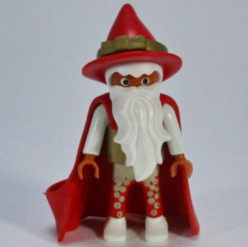
Here is my attempt at a comprehensive guide to all PM hair types, presented as an 8-page pdf
Here is a version in Excel, which is easy to scroll horizontally to see all types
Hair-Types-01-Jan-2026-scrollable-spreadsheet
All known hair types issued to the end of 2025 are included.
The top row on each page shows a description of each group of hair types. Similar hair pieces are grouped together depending on;
- Whether or not a hat fits on top of the hair (39 types plus two hair extensions which only fit these types)
- The length of the hair (short hair does not reach to the bottom of the neck; long hair extends below the shoulders)
- The presence of a bun, ponytail, pigtails, braid, plait or bow, usually at the back of the head
- Whether the hair is removable or not
- Whether the hair is used on male or female klickies (a few have been used on both genders, so this is not always a helpful distinction)
- Hair extensions, Children and Babies are grouped together
The year the hair type was first released is shown on the second row.
The next three rows give names of the hair types:
- Name of the Character which originally had this hair style (Super 4, How to Train Your Dragon (HTTYD), Spirit, Heidi, Back to the Future, Ghostbusters, James Bond, Dragons Nine Realms, Everdreamerz, Ayuma, Dino Rise, Asterix, Star Trek, A-team, Naruto, Miraculous figures)
- PlaymoDB name for the hair piece (description also used in ‘Find a klicky’): Many styles do not yet have PlaymoDB names in ‘Find a Klicky,’ so these have names I have invented, in red.
- Geobra name from playmobil website, usually in German
The sixth row gives the number assigned by SonParaMiHijo in his removable hair guide here (The numbers are in order of release date)
The seventh and eighth rows give the number of male and female klickies shown in PlaymoDB to have the hair type, up to December 2019 (it has proved too difficult to update these figures with any accuracy), with a few additions for more recent releases.
On the ninth row I have stated whether the hairstyle appears symmetrical when viewed from the front/back.
The photos show the front, back, side and top views of the hair-piece, usually on a plain face, no beards included. I still need to add a few photos, e.g. klingons.
The lower part of each page shows in what colours each hair type is known, together with the numbers of up to 4 sets which contain that hair.
Cells with a green tint show the 8-digit part numbers for the hair piece in the stated colour, where part numbers are known
Orange-coloured cells show where the hair piece exists in the stated colour, but the part number is currently unknown.
This chart was updated on 29 July 2025.
How many hair types?
The chart includes:
- 215 distinct types of hair:
- 189 interchangeable types (45 with hat, 120 no hat), of which
- 11 are hair extensions (6 fit non-hat hair, 5 fit hat-hair) and
- 9 types have limited interchangeability (alien/grasshopper, 3 Super 4 characters, 3 Klingons, Dr. Emmett Brown).
- 23 non-interchangeable types (9 children, 3 babies, 3 small adults, 1 child-sized robot, 6 Super 4 characters, B A Barabus).
- 3 non-hair types (2 rabbits and a Sykronian alien)
- 189 interchangeable types (45 with hat, 120 no hat), of which
- about 669 part/ colour variants
- 332 Part number unknown (orange tinted cells)
- 198 Part number known (green tinted cells)
- 139 children, small adults, babies and other non-removable hair (this figure includes all head variants as only whole heads can be interchanged, but is almost certainly an understimate)
Other hair guides
The first comprehensive guide I found online was the one created by Juliane on Klickywelt.de. Juliane’s guide shows photographs of 88 interchangeable hair types, in every colour currently available (383 variants!). I used this guide extensively in preparing earlier versions of my own guide. Juliane also includes a guide to PM beards. Sadly, neither the hair nor beards guides have been updated for several years.
More recently, SonParaMiHijo has created a guide in Spanish here on the Amclicks forum which he keeps up to date. He has been very helpful in pointing out errors in earlier versions of my guide. The beauty of SPMH’s guide is that it lists the hair types (pelos) in order of date, along with comments on how each may be useful for customising. Non-removable hairs (children, babies, some Super4, Asterix and other figures) are not included.
Another source of hair pictures (128 style/colour combinations for no-hat styles) is on Nic’s Green Man site. Again, this is now a few years out of date.
Which hair pieces are currently available to buy from DS?
To check, enter a part number (without spaces) in the Find Spare Parts facility at playmobil.co.uk. All known part numbers for hair parts are given in the chart, in a cell with a green tint. Where the part number is unknown, I have just stated the colour and the cell has an orange tint.
Which sets are they in?
I have given up to four set numbers for each style/ colour combination.
On PlaymoDB, search for the hair type and colour on ‘Find a klicky’. This will display all klickies in the DB with that hair; to find the sets each klicky comes from, click on the green camera symbol and you will be taken to a ‘klicky page’ listing all sets that klicky is found in. If there is no camera symbol next to a klicky, enter the klicky part number (with dashes or spaces or none) in the following URL, in place of the part number already there http://playmodb.org/cgi-bin/klicky.pl?partnum=30-14-5450
Colours
There are at least 30 basic colours of hair. Colour descriptions can depend upon the observer, there can be variations between different manufacturing batches and colours can fade.
Year of first release
Not yet updated with 2025 releases.
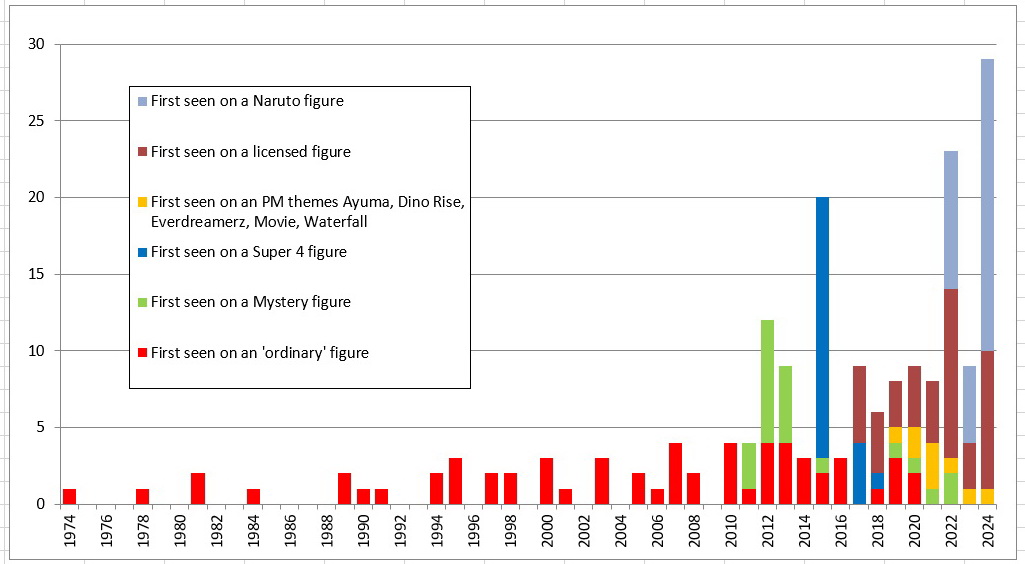
It’s interesting that the earlier Mystery Figures (green) had many more new hair styles than more recent ones. The Playmobil ‘in house’ theme Super4 (blue) had many new styles in its first year, but later ‘in house’ themes (yellow) had fewer new hairstyles. Since 2017, many new styles have been introduced in Licensed themes (brown), especially the 51 Naruto sets in 2022-4 (light blue) which contributed 28 new hairstyles plus 3 hair extensions. It has become increasingly difficult to keep up with new releases!
Early hair types
Juliane includes ‘old’ brown (braun), yellow (gelb) and orange versions of ‘classic’ male and female hair; on early klickies the plastic quality was different so the hair often looks paler than more modern counterparts (and they may have faded with age too).
Three or four different molds have been used for the classic male and classic female hair styles. On more recent examples, the top of the head (above the ‘hat line’) has a small flat area at the back.
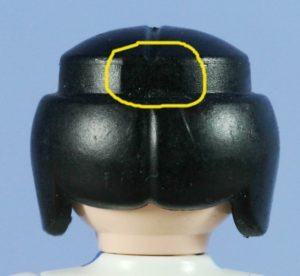
On earlier molds, this was either a straight line indentation or ‘notch’, a V-shaded notch or a U-shaped notch.
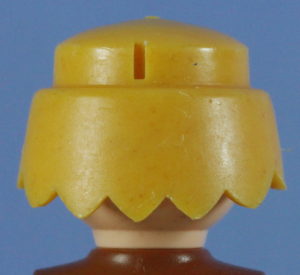
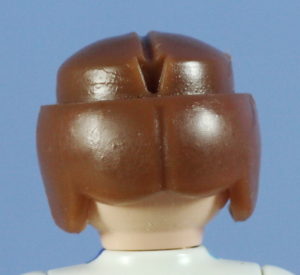
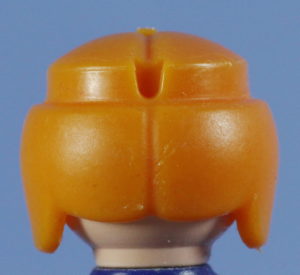
I have also seen the U-shaped notch on the early ‘bun in back’ hairstyle in grey. I think it likely that the various ‘notch’ types were only used before about 1985, on black, brown, blond, grey and orange styles in use back then.
Redesigned pony-tail
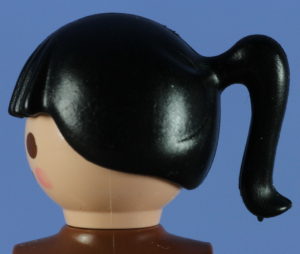
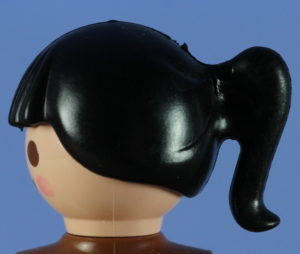
A few years ago, Geobra redesigned the ‘high ponytail’ style found on female klickies, presumably because on the older style the ponytail easily snaps off. The newer ones are identical in all respects, but have a reinforced pony tail (see photos). Each colour appears to have the same part number as the old counterpart. I have listed them as separate styles in my table, but they are arguably the same style, one an updated version of the other.
Redesigned chainmail
Another style which was redesigned is the chainmail hair. The new design allows helmets to fit over the hair more readily.
“Wigs”
Some hair parts have been manufactured to be easily removable ‘wigs’, with a cross-shaped piece on the underside. In at least three cases, the same parts are available in the ‘standard snap-on’ style in the same colour.

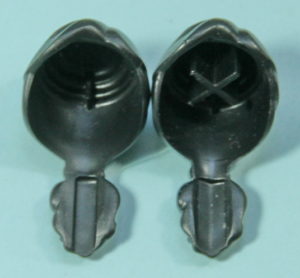
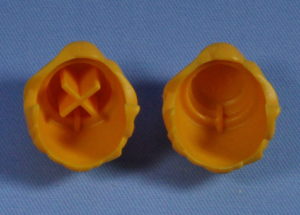
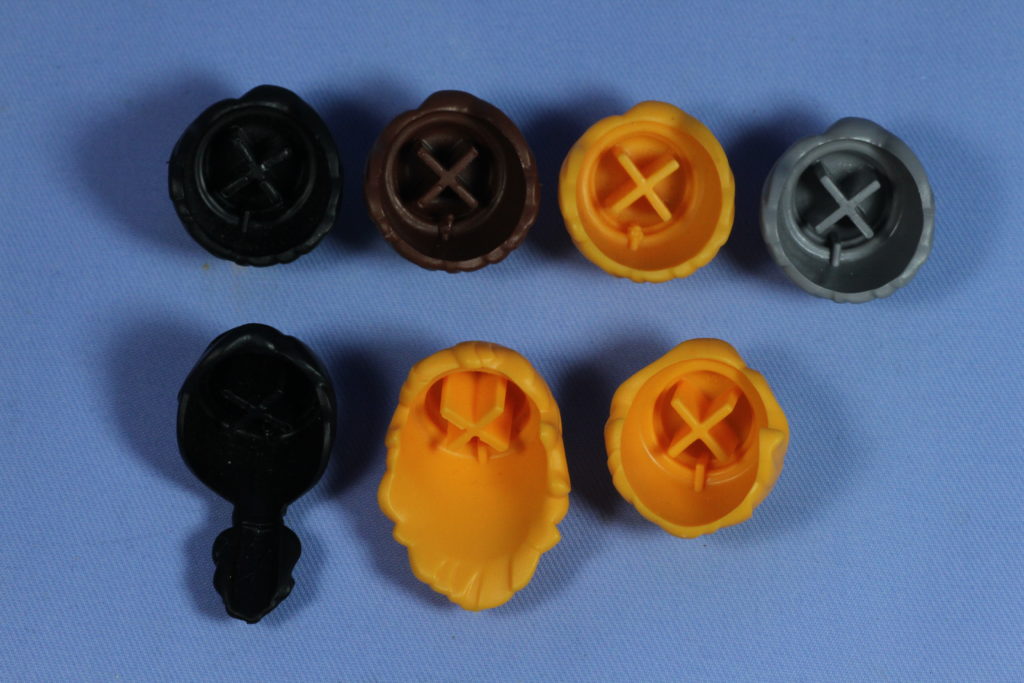
Here is a list of the twelve wigs I have found, with part numbers where known. I think it is likely all “chin-length bob” hairpieces are ‘wigs’ (the German name for this part ‘Wechselperücke-Halblang’ means ‘exchangeable wig-half long’) and so are most “shoulder-length loose curls” – certainly nearly all the examples of these two styles which I have checked have been wigs.
- Wig (hair), loose ponytail (no hat) in black (this is also available in a ‘snap on’ form)
- Wig (hair), loose ponytail (no hat) in light brown (30 24 4050 in set 4413)
- Wig (hair), shoulder-length loose curls in blonde (5 klickies in 7 sets)
- Wig (hair), shoulder-length loose curls in red-brown (set 4752)
- Wig (hair), shoulder-length loose curls in black (30 24 3710 in set 4413 and 6 other klickies, though some of these might have the standard ‘snap-on’ hair)
- Wig (hair), shoulder-length loose curls in light brown (sets 4668 and 4279)
- Wig (hair), chin-length bob in black (30 25 5600?, found on 18 female klickies)
- Wig (hair), chin-length bob in blonde (30 24 3750 in set 4413 and on 5 female klickies)
- Wig (hair), chin-length bob in grey (30 24 2582 on two female klickies)
- Wig (hair), chin-length bob in brown (in Special 4697)
- Wig (hair), chin-length bob in yellow (shown on Juliane’s chart, origin unknown)
- Wig (hair), styled female (no hat) in blonde (30 24 4040, German name “Wechselperücke-Fönfrisur” or ‘exchangeable wig blow-dried’) as opposed to 30 02 0340, “Perücke-Frau-Fönfrisur” or ‘woman’s blow-dried hairdo’, the snap-on version of the same hair, in blonde and also in other colours)
Corrections?
If you have any corrections or additions to the information, please let me know and I will gladly include them in the chart. I will update the file in the link, so the most up-to-date version is available.
Latest edit: 01 January 2026